Workshop 4: The SCARF Model (David Rock)
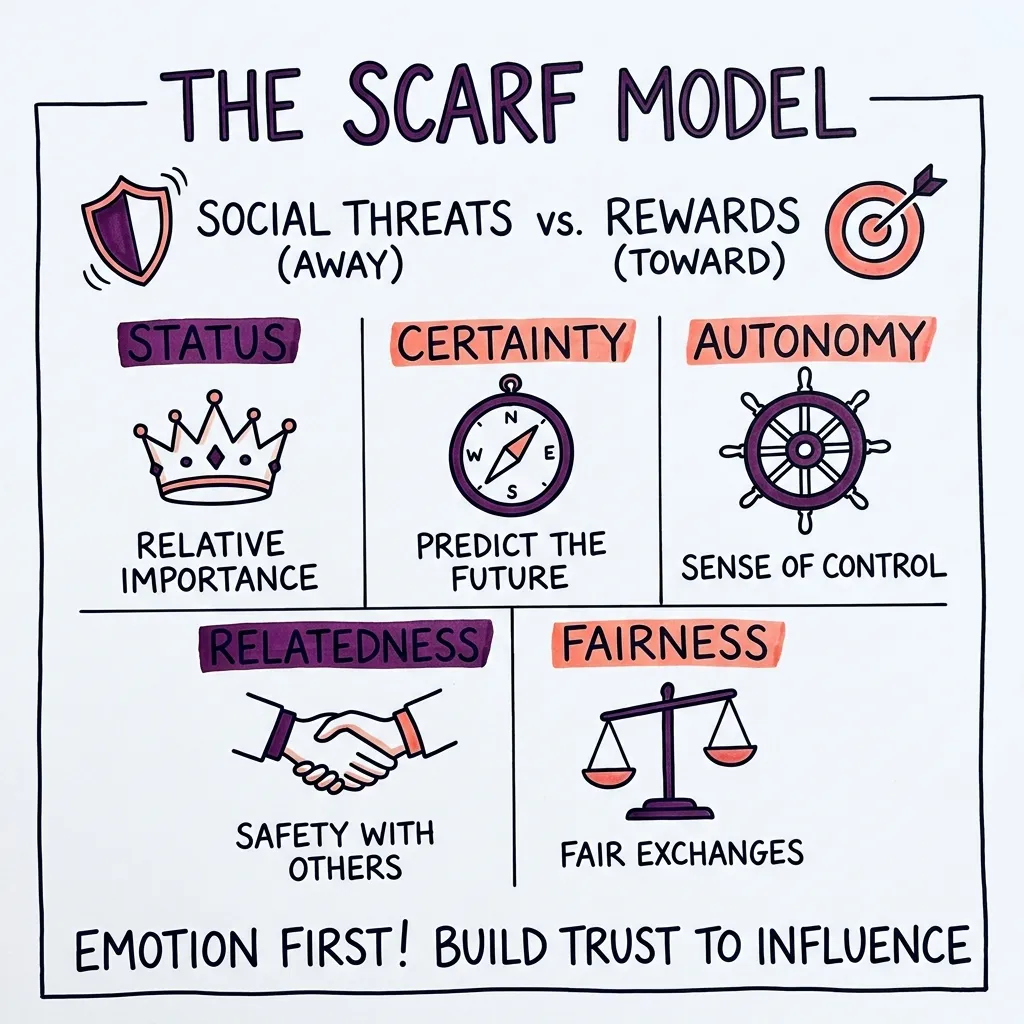
The SCARF Model is a tool that helps to improve interpersonal relationships by adapting our communication based on the 5 SCARF domains. Introduced by David Rock in 2008.
The SCARF Domains
SCARF models social threats and rewards. Communication either triggers an “AWAY” (Threat) response or a “TOWARD” (Reward) response.
1. Status
Relative importance to others.
- Threat: Questioning legitimacy or authority.
- Reward: Reaffirming authority, appreciation, recognizing expertise.
- Communication Tip: Use appreciation, acknowledge their expertise.
2. Certainty
Ability to predict the future.
- Threat: Questioning perception, assumptions, or lack of clarity.
- Reward: Agreeing on perception and assumptions, providing structure.
- Communication Tip: Be clear, give timelines, reduce ambiguity.
3. Autonomy
Sense of control over events.
- Threat: Questioning ability to make decisions (micromanagement).
- Reward: Respecting decisions and actions, offering choices.
- Communication Tip: Offer options, invite input on decisions.
4. Relatedness
Sense of safety with others (friend vs. foe).
- Threat: Questioning belonging to the group, isolation.
- Reward: Celebrating feeling of belonging, sharing stories.
- Communication Tip: Show empathy, use inclusive language (“we”).
5. Fairness
Perception of fair exchanges.
- Threat: Unexplained rationale, inconsistency, perceived favoritism.
- Reward: Treating everyone the same, transparency.
- Communication Tip: Explain rationale, ensure consistency.
Practical Application: Identification
Participants identified domains in common scenarios:
- “I am Carmen from District 51. Nice meeting you today. What a hot day today.” → Relatedness
- “How do I register? Do I tell you my name and club name or?” → Certainty
- “I am Carmen, the Past District Director from D51. How do I register?” → Status
- “Is this the same registration process for everyone?” → Fairness
- “May I choose either counter for registration?” → Autonomy
Conclusion
- When we communicate to build trust, we can influence better.
- Effective communication can be adapted based on SCARF domains.
- Applicable for all situations: Toastmasters, corporate world, business, and relationships.
Emotion first! Just let people talk about whatever they like first, then wrap up with what you really want.
Reference: District 97 Conference 2026