AI-Driven Development Lifecycle (AI-DLC)
The AI-Driven Development Lifecycle (AI-DLC) aligns tools, roles, and software development ceremonies to optimize human-AI collaboration.
The Human-AI Collaboration Model
AI creates plan ➔ Human verifies plan
AI executes plan ➔ Human verifies outcome
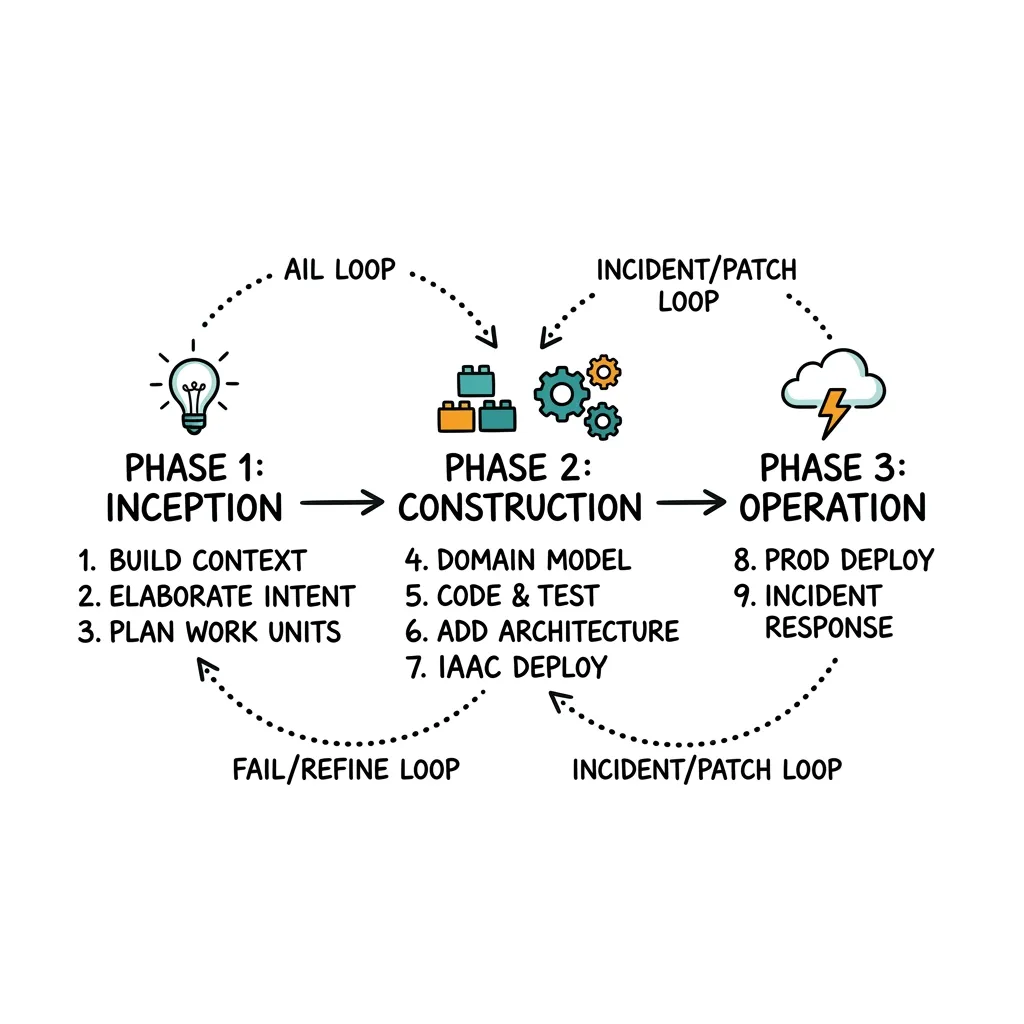
Three Phases & Nine Adaptive Steps
The lifecycle is split into three core phases where each stage builds a richer context for the next. The stages are “Adaptive” based on the user’s intent.
Phase 1: Inception (Mob Elaboration)
In this phase, requirements are gathered, and context is established.
- Build Context on Existing Code: AI and human explore the codebase to map dependencies and patterns.
- Elaborate Intent with User Stories: Convert raw business ideas into structured user stories.
- Plan with Units of Work: Break down stories into small, bite-sized tasks that fit within an LLM’s context window.
Phase 2: Construction (Mob Construction)
Code is generated, tested, and staged. 4. Domain Model (Component Model): Define structural interfaces, database schemas, and architectural boundaries. 5. Generate Code & Test: Write implementation code alongside comprehensive unit and integration tests. 6. Add Architectural Components: Integrate with cloud resources, middleware, and backend services. 7. Deploy with IaaC & Tests: Package deployment using Infrastructure as Code (e.g., Terraform, AWS CloudFormation) and execute testing.
Feedback Loop: If construction tests fail or expose design gaps, a dotted feedback loop returns to the Inception phase to refine the plan.
Phase 3: Operation
The software is run and maintained in production. 8. Deploy in Production with IaaC: Safely push code to production environments. 9. Manage Incidents: Monitor performance and utilize AI agents to help debug and patch issues.
Feedback Loop: Production incidents or scaling requirements route back into the Construction phase for rapid patching.