Multi-Region Deployment Challenges
Speaker: Dr. Vit (DailiTech)
Core Architectural Philosophies
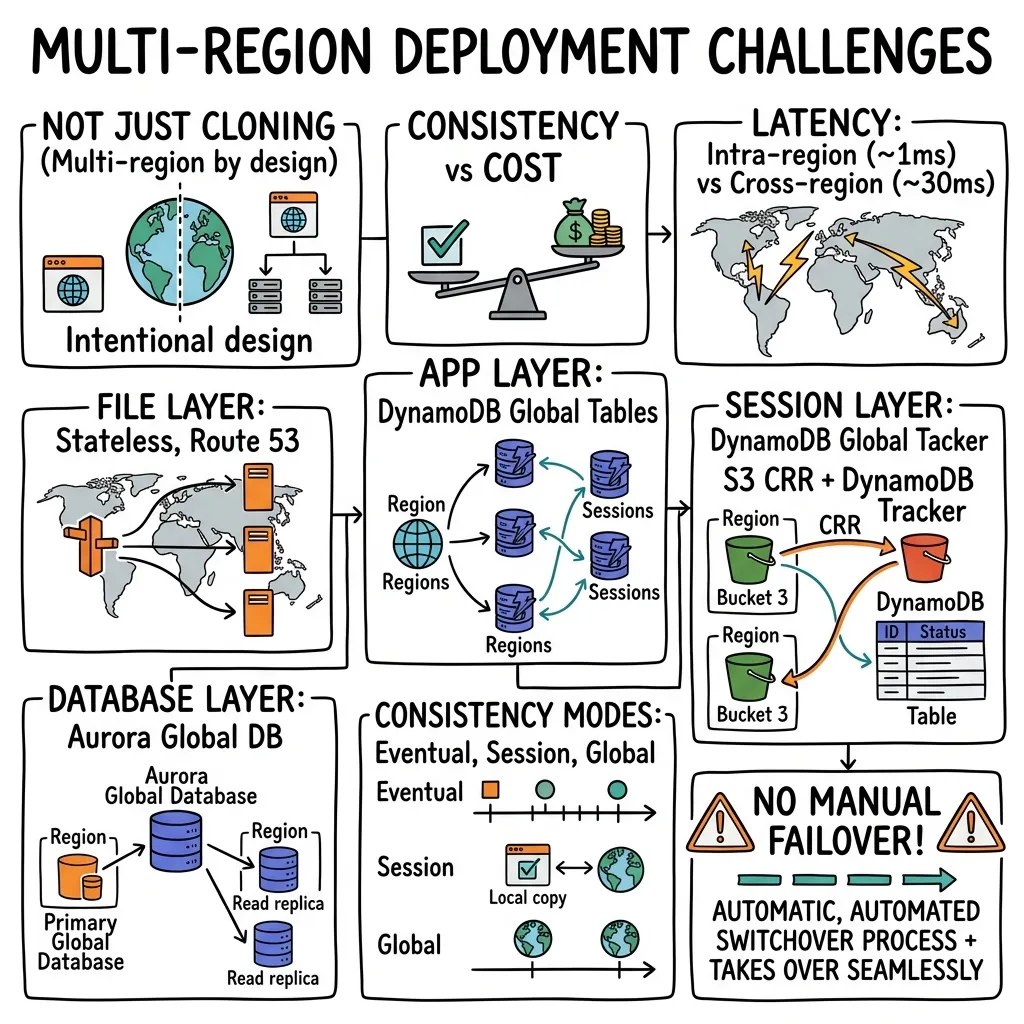
- Not Just Cloning: Multi-region deployment is not about copying Region A resources to Region B. It requires multi-region by design.
- No Manual Failover: The system should dynamically handle failovers without human intervention.
- Consistency vs. Cost: Design for eventual consistency by default. Introduce strong consistency only where money or life safety is involved.
- Latency Realities: Intra-region latency is extremely fast (
\sim 1\text{ ms}), but cross-region latency (e.g., Thailand to Singapore) introduces a physical limit (\sim 30\text{ ms}).
Architectural Layers & Consistency Patterns
1. Code / Application Layer (Stateless)
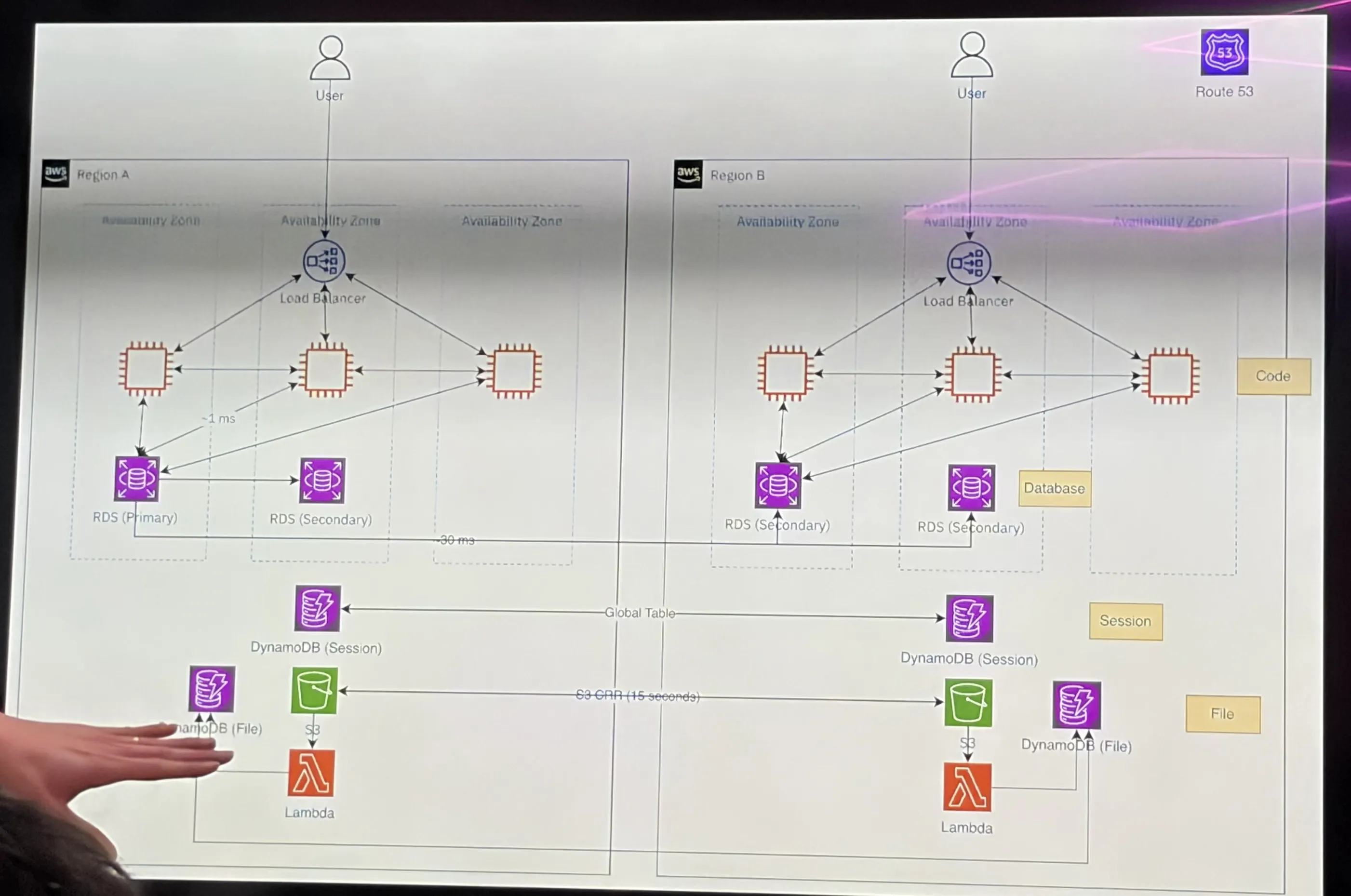
- Pattern: Deploy active-active stateless application nodes behind Load Balancers in both regions (Region A and Region B) managed by Route 53 DNS routing.
- State: Keep application servers stateless to make regional scaling trivial.
2. Session Layer (DynamoDB Global Tables)
- Problem: Users logged into Region A must stay logged in if routed to Region B.
- Pattern: Store sessions, permissions, JWT revocation lists, and refresh tokens in DynamoDB (Session).
- Technology: Leverage DynamoDB Global Tables for automatic, bidirectional active-active replication with sub-second latency.
3. File Layer (S3 CRR + DynamoDB Status Tracker)
- Problem: Writing files to S3 in Region A takes time to replicate to Region B via S3 Cross-Region Replication (CRR), which guarantees 15-minute replication but often completes faster.
- Technology: S3 CRR replicates files across regions (typically takes
\approx 15\text{ seconds}). - Fallback Pattern:
- A file is uploaded in Region A
\rightarrowLambda writes metadata to DynamoDB (File) and marks the file aslocal_only. - DynamoDB (File) replicates instantly to Region B via Global Tables.
- A user in Region B requests the file. The local Lambda checks DynamoDB (File).
- If the record says
local_only(not yet replicated to Region B S3), the Region B Lambda falls back and pulls the file directly from Region A’s S3 bucket. - Once S3 CRR completes, the replication status is updated, and Region B serves it locally.
- A file is uploaded in Region A
4. Database Layer (Aurora Global Database)
- Technology: Use Aurora Global Database with RDS (Primary) in Region A and read-only RDS (Secondary) in Region B.
- Replication Speed:
- Intra-region replication (Primary
\rightarrowSecondary in Region A):\sim 1\text{ ms}. - Cross-region replication (Region A
\rightarrowRegion B):\sim 30\text{ ms}.
- Intra-region replication (Primary
- Consistency Modes:
- Eventual: High performance, read-replicas may lag slightly.
- Session: Guarantees a user reads their own writes.
- Global: Strong consistency across all regions, but increases latency because write operations wait for cross-region ACKs.