How to Build an AI-Native Services Company
URL: https://www.youtube.com/watch?v=gSNFJbgoaHI
Summary
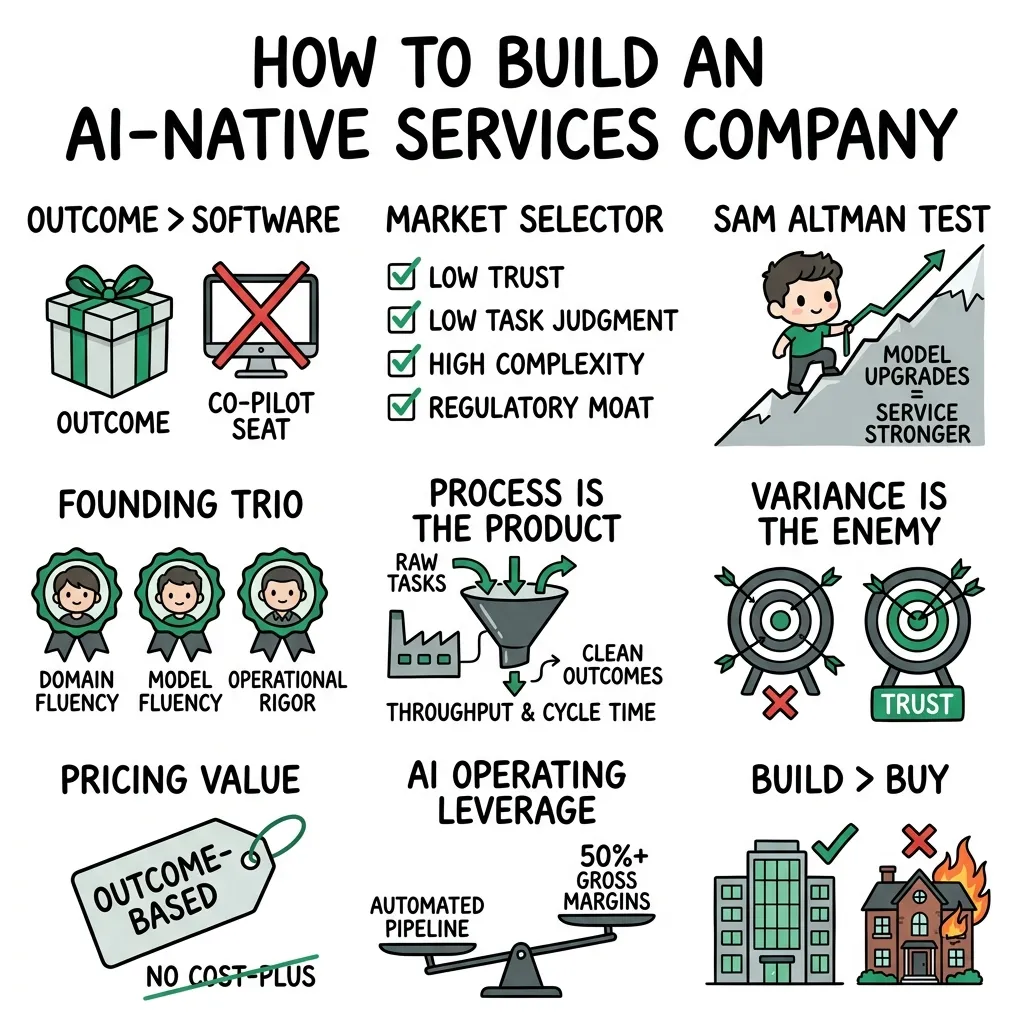
In this Y Combinator guide, the presenter outlines the playbook for starting and scaling AI-Native Services Companies—businesses that deliver final outcomes (e.g., tax returns, legal contracts, FDA filings) rather than selling software licenses (co-pilots). By combining frontier AI models with human-in-the-loop workflows, these companies leverage “AI operating leverage” to achieve software-like gross margins (~50%+) on a much larger Total Addressable Market (TAM) than traditional SaaS.
Details
1. Reconceptualizing AI Services
- Outcome vs. Tool: Traditional SaaS sells software seats (co-pilots) that require the customer to do the work. AI-native services sell the completed outcome itself, replacing external vendors.
- TAM Advantage: Rebuilding services (law, tax, audit, insurance, medicine logistics) targets multi-trillion-dollar labor markets rather than smaller software budgets.
2. Market Selection Criteria (The 4 Traits)
To build a viable AI-native service, the chosen market should exhibit:
- Low Trust (Outsourced Budget): The client already outsources the work and cares about the end product, not how it is made. You step into an existing budget.
- Low Judgment at the Task Level: Steps within the process can be broken down. Most steps must be automated, while human judgment is reserved for specific checkpoints.
- High Intelligence Threshold: The work must be hard enough to require the combination of frontier models and expert humans.
- Regulation as a Moat: Heavily regulated spaces have strict quality bars and accountability, raising barriers to entry (e.g., FDA approvals, mortgage underwriting).
3. The Sam Altman Test
- When evaluating a market/service, ask: “As frontier models get better, does your service get stronger, or does the model itself commoditize you?”
- You want your proprietary operational pipeline, domain expertise, and dataset to become more defensible as the underlying LLM intelligence increases.
4. The Founding Team Profile
The best founding teams share three distinct characteristics:
- Domain Fluency: Credibility to sell to skeptical buyers in regulated industries.
- Model Fluency: Knowing what frontier models can do today and building to ride the curve as they improve.
- Operational Rigor: Deep respect for workflows, SOPs, throughput, and variance.
5. Building the Product & Managing Operations
- Process is the Product: The software is built for internal humans in the loop, not the client. The product is the optimized pipeline that allows these experts to scale nonlinearly.
- Variance is the Enemy: Customers churn due to inconsistency (variance) far more than speed or price. Standardizing outputs is the primary product engineering challenge.
- Nonlinear Scaling: If revenue scales 1:1 with human count, the company is just a traditional consulting shop. Automation must drive exponential output per human.
6. Sales, Pricing, and the Early Demand Trap
- The Early Demand Trap: It is easy to sign pilot clients, but too much demand early on forces you to hire humans to paper over product gaps, preventing automation scale. Cap pilots to a small handful initially.
- Pricing:
- Do: Use per-unit pricing (per return, per study) or value-based outcome pricing.
- Avoid: Cost-plus pricing (caps upside) and straight-line undercutting (makes the product look low-quality).
7. P&L & AI Operating Leverage
- COGS Breakdown: Model APIs, hosting, and human-in-the-loop labor constitute cost of goods sold.
- Gross Margins: Traditional service firms top out at ~30% gross margins. Pure software is 80%+. The goal of an AI-native services company is to use product automation to achieve 50%+ gross margins over time.
8. Don’t Buy Your Way In
- Buying an existing, legacy services firm to inject AI is a common trap. Legacy firms have entrenched cultures, different metric profiles, and high friction. Building from scratch is almost always superior to buying.
My Takeaways
- Focus on Outcomes: The transition from selling tools (“co-pilots”) to selling outcomes is a major shift in AI business models. Customers want their problems solved, not another software tool to learn.
- Rethinking COGS: For software engineering, viewing human labor as part of COGS (Cost of Goods Sold) requires a change in mindset. The metrics of success shift to operational throughput, cycle time, and variance control.
- Quality & Trust: Trust is built on predictability. In AI pipelines, minimizing variance through deterministic checks, structured outputs, and human evaluations is more critical than raw speed.