Summary
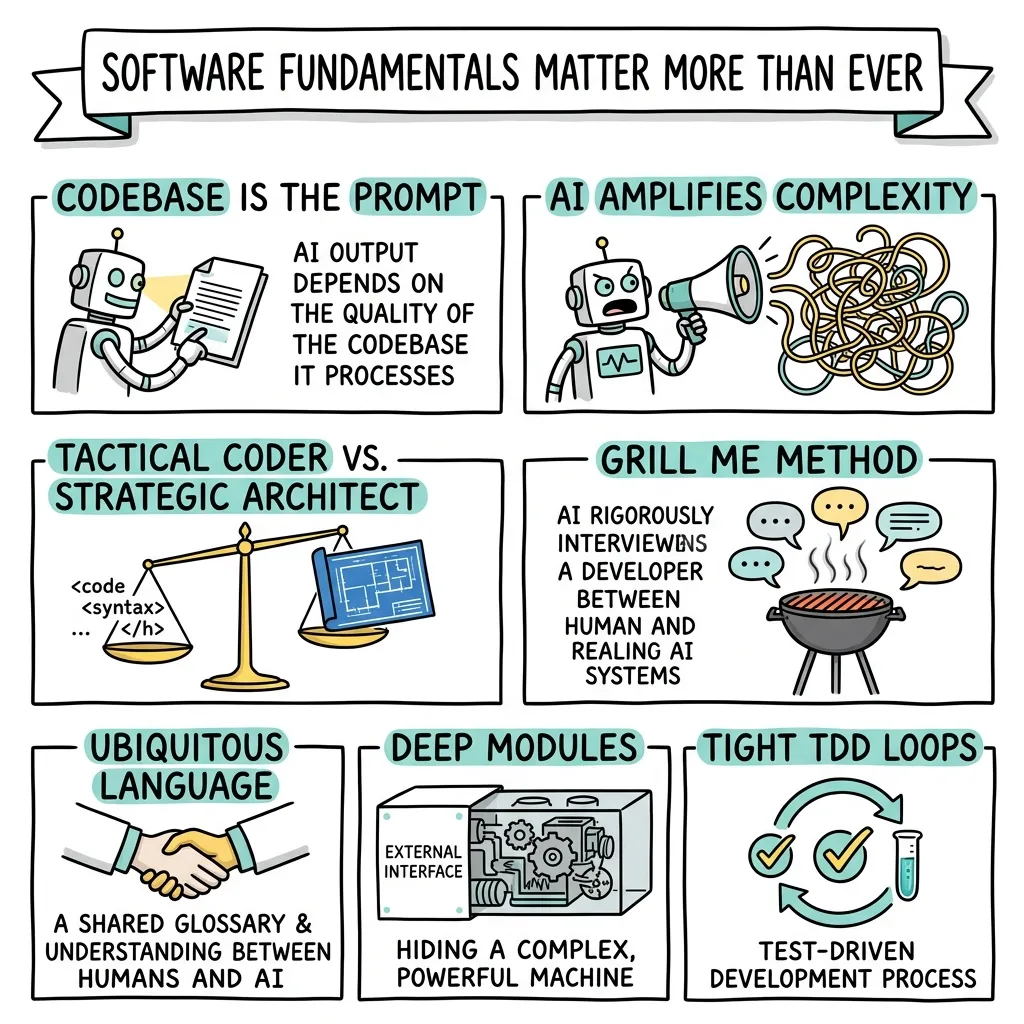
TL;DR: AI makes syntax generation cheap, but bad codebase quality and high complexity are more expensive than ever. Matt Pocock argues that AI amplifies whatever patterns are already present in a codebase, without any inherent resistance to complexity. To build sustainable systems, developers must transition from tactical “coders” to strategic architects by mastering software fundamentals like deep modules, ubiquitous language, tight feedback loops (TDD), and AI requirement clarification (“Grill Me”).
A video by Matt Pocock discussing why strong engineering fundamentals are increasingly critical in an age where AI can write code. As syntax generation becomes commoditized, a developer’s true value lies in understanding system architecture, design patterns, and sustainable software practices.
Details
1. The Codebase is the Prompt (AI as a Complexity Amplifier)
- AI Lack of Intentionality: AI models generate syntax quickly but lack any inherent instinct to resist complexity or maintain clean boundaries. If given a messy codebase, they will generate spaghetti code, driving rapid software entropy.
- The Amplifier Effect: AI amplifies whatever pattern is already dominant. Clear architectural boundaries lead to high-velocity generation; unorganized codebases result in chaotic, bug-ridden suggestions.
2. The Shift from Tactical Coder to Strategic Architect
- Tactical Coding: Writing syntax line-by-line is becoming a commodity. Relying solely on “vibe coding” (uncritically accepting AI suggestions) leads to long-term maintenance debt.
- Strategic Architecture: Developers must spend their cognitive budget designing strong module interfaces, mapping data flows, and verifying AI outputs. Code must be treated as a long-term investment, not a cheap, disposable commodity.
3. Establishing Shared Design Concepts
- The “Grill Me” Method: Instead of providing vague prompts, developers should instruct the AI to ask them a series of questions (clarifying requirements, data models, edge cases, and failure modes) before writing any code.
- Ubiquitous Language: Utilizing a shared, consistent vocabulary across conversations, documentation, and source code. This minimizes translation friction and aligns the developer’s intent with the AI’s generation.
4. Modular Design & Deep Modules
- Deep Modules: Defined by John Ousterhout as modules that provide powerful functionality behind simple, narrow interfaces.
- Reducing Cognitive Load: Deep modules hide complex implementation details, making them easier to test and highly legible for both humans and AI agents.
- Contrast with Shallow Modules: Avoid shallow modules where the interface is as complex as the implementation, as they increase integration overhead.
5. Tight Feedback Loops & Disciplined Iteration
- Test-Driven Development (TDD): TDD enforces small, deliberate, and verifiable changes. Tests serve as unambiguous constraints for the AI.
- Controlled Generation: Generating small chunks of code within a tight test loop prevents the AI from deviating or introducing unexpected side effects.
My Takeaways
- Implement the “Grill Me” prompt pattern in daily AI coding workflows to specify requirements more rigorously.
- Review codebase architecture to identify and consolidate shallow modules into deep modules.
- Practice stricter TDD loops when letting AI generate code blocks.